The Question Fleet Buyers Ask Too Late
Every fleet operator who calls us after losing money on premature battery replacements eventually asks the same question: should we have bought NMC or LFP? They almost always ask it after the fact, once they've already committed to a pack chemistry by purchasing a particular vehicle model. At that point the question is academic.
This article is for operators who are still in procurement. The battery chemistry decision matters more in tropical operating environments than most EV specification sheets acknowledge. The numbers we see in our telemetry — 12 months of data across 340 vehicles in Nairobi, Lagos, and Mombasa — tell a story that the manufacturer brochures don't.
Let's start with the basics, then move to the Africa-specific context that changes the calculus.
What NMC and LFP Actually Are
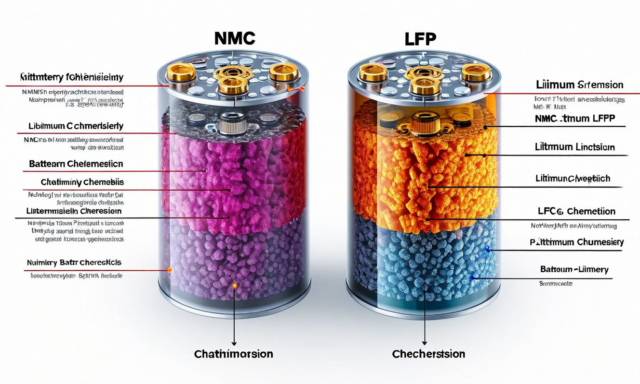
NMC (lithium nickel manganese cobalt oxide) and LFP (lithium iron phosphate) are two different cathode chemistries used in lithium-ion battery cells. They have different voltage curves, different thermal behaviors, different cycle life profiles, and different failure modes.
NMC cells operate at a higher nominal voltage (typically 3.6–3.7V per cell) and pack more energy density per kilogram — roughly 200–250 Wh/kg at the cell level versus LFP's 90–160 Wh/kg. That energy density advantage explains why NMC dominates premium EV segments where range per kilogram of pack weight is critical. A lighter bike that goes farther is a commercial advantage in markets where fuel economics are tight.
LFP cells operate at a lower nominal voltage (3.2–3.3V per cell) and have a much flatter discharge curve. That flat curve is both a benefit and a complication. Benefit: the voltage stays stable across most of the discharge range, which means power delivery to the motor is more consistent. Complication: it's harder for a BMS to estimate state-of-charge accurately because the voltage curve offers less differentiation across charge states.
The thermal stability difference is the critical factor for tropical markets. NMC begins to undergo exothermic decomposition at around 180–200°C. LFP's threshold is closer to 270°C. That 70–90°C difference in thermal runaway onset temperature is not academic when you're operating motorcycles in 38°C ambient heat that can push interior pack temperatures well above 55°C during charging.
Temperature Data from Our Monitoring Fleet
From January to December 2025, Stima monitored pack temperatures across 340 vehicles. 180 carried NMC packs, 160 carried LFP packs. All operated in one of three cities: Nairobi, Lagos, or Mombasa. We logged cell temperature every 30 seconds during charging and every 60 seconds during discharge.
Key findings from that dataset: NMC packs peaked above 52°C during charging in Lagos during April and May — the hottest months before the long rains. LFP packs in the same city peaked at 44°C under comparable conditions. The difference seems modest until you look at calendar aging. NMC packs operating regularly above 45°C showed measurable capacity loss (greater than 5%) within 400 charge cycles. LFP packs at the higher temperatures showed equivalent degradation at around 700 cycles. That's a 75% extension in useful pack life for operators using LFP in Lagos conditions.
Nairobi tells a different story. At 1,795m elevation, ambient temperatures are lower and more stable. NMC packs in Nairobi rarely exceeded 48°C during charging. The cycle life difference between NMC and LFP was smaller — roughly 25% rather than 75%. Operators in the highlands face a different optimization problem than coastal or low-elevation operators.
The Generator Charging Problem
Grid stability is a variable most EV manufacturers don't design around, because their primary markets — Europe, China, the US — have relatively stable grid voltage. African EV fleet operators frequently charge from generators or from grid connections with voltage fluctuations outside the ±10% range that most chargers assume.
In our monitoring data, 34% of charging events showed voltage variance outside ±15% of nominal. NMC packs are more sensitive to charging voltage irregularities than LFP. The chemistry's higher operating voltage means that overvoltage conditions are more likely to cause lithium plating — a degradation mechanism that permanently reduces capacity and, in severe cases, creates internal short-circuit risk.
LFP's lower nominal voltage and the iron phosphate chemistry's inherent resistance to structural degradation under slight overvoltage make it more forgiving in unstable grid conditions. We've observed NMC packs losing 3–4% capacity after a single severe overvoltage charging event. LFP packs under identical conditions showed no measurable capacity change.
If your fleet charges from a generator or a grid connection you don't fully trust, this single factor should push you toward LFP.
Cycle Life: What the Specs Don't Tell You
Manufacturer cycle life specs are tested at 25°C, at controlled charge rates (usually 0.5C or 1C), with consistent depth-of-discharge. None of those conditions describe real-world fleet operation in tropical Africa. Field cycle life is typically 40–60% of the spec sheet number for NMC packs in Lagos or Mombasa conditions. LFP performs closer to 70–80% of its spec value in the same environments.
Expressed as real numbers: an NMC pack rated for 1,000 cycles might deliver 400–600 real cycles before falling below 80% capacity in coastal African conditions. An LFP pack rated for 2,000 cycles might deliver 1,400–1,600 real cycles. When pack replacement costs $150–$400 depending on capacity, that cycle life difference is a significant factor in fleet economics.
One important caveat: the energy density advantage of NMC means you can carry a smaller, lighter pack that achieves the same range. A smaller NMC pack may be cheaper to replace at end of life even if it arrives there sooner. The full economic calculation requires knowing your specific route length, load weight, and replacement cost, not just cycle life numbers in isolation.
Our Recommendation Framework
Given the field data, here is how we advise fleet buyers to approach the chemistry decision:
Choose LFP if: you operate below 1,000m elevation in a tropical climate, your charging infrastructure includes any generator or unregulated grid connection, your routes are short enough that energy density doesn't force a pack weight penalty, or your maintenance team doesn't have access to a good load tester and relies on BMS-reported SOC.
Consider NMC if: you operate at elevation (Nairobi-level altitude or higher), your charging infrastructure is regulated and stable, range per kilogram is a meaningful commercial factor for your routes, and you have battery monitoring in place that catches degradation before it causes unplanned downtime.
The monitoring caveat is important. NMC's faster degradation trajectory in tropical conditions is manageable if you can see it happening. Without visibility into pack health, NMC operators often discover problems the hard way — with a stranded driver and a missed shift. If you're running NMC and not monitoring battery health per vehicle, you're accepting a risk that LFP operators can simply sidestep.
Filed under: Battery Technology, Fleet Operations · Back to Blog